
Analysis
Space Economy Outlook 2026
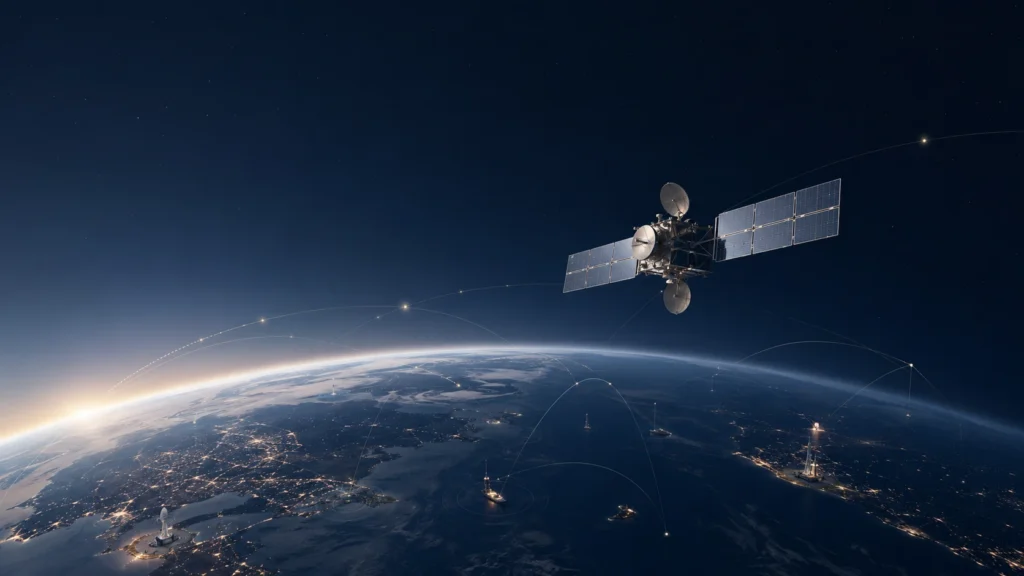
Global trends, investment and market dynamics shaping the next phase of sustainable growth
The global space economy enters 2026 with strong momentum, but its development is becoming more complex. Growth is no longer defined only by launch records, new spacecraft or ambitious exploration programmes. The sector is increasingly shaped by recurring services, strategic government demand, private capital discipline and the need to protect the orbital environment on which future growth depends.
Estimates of the space economy vary because institutions measure different activities. The Space Foundation valued the global space economy at $613 billion in 2024, representing 7.8% annual growth, while the World Economic Forum and McKinsey used a broader definition to estimate $630 billion in 2023. The difference highlights an important challenge: the space economy is expanding faster than the systems used to consistently define and measure it.
Despite these methodological differences, the direction is clear. Space-based infrastructure is becoming increasingly integrated into communications, navigation, defence, climate monitoring, agriculture, logistics and financial systems.
From spacecraft to services
One of the most important changes in 2026 is the movement of economic value from assets in orbit to the outcomes they provide on Earth.
Customers increasingly purchase connectivity, positioning, environmental intelligence and persistent monitoring rather than satellites themselves. This creates the possibility of subscription-based and recurring-revenue models, making some space businesses less dependent on one-time hardware contracts.
The European Space Agency estimated the downstream space market—including satellite communications, Earth observation and navigation-related services—at approximately €490 billion in 2025. GNSS-related services accounted for 77% of this market. By comparison, the upstream market for spacecraft manufacturing and launch services was valued at approximately €75 billion.
This imbalance shows where most economic value is currently created: not only in reaching orbit, but in converting space infrastructure into useful and scalable services.
Investment is recovering—but becoming more selective
Private investment in space ventures increased significantly during 2025. ESA reported a 60% global rise, driven primarily by a sharp increase in United States activity. European space ventures raised approximately €1.4 billion, the region’s second-highest annual total, although this remained 8% below 2024.
The recovery does not represent a return to indiscriminate funding. Investors are placing greater emphasis on identifiable customers, recurring revenue, technical readiness and credible paths to scale. Companies dependent on long development cycles without near-term demand continue to face greater financing pressure.
This shift may strengthen the sector over time. Capital is increasingly directed toward businesses able to demonstrate operational relevance in areas such as Earth observation, satellite connectivity, defence, navigation, space-domain awareness and infrastructure services.
Government demand is becoming more strategic
Governments remain central to the space economy, particularly in upstream infrastructure and emerging technologies.
According to ESA, global public investment in space reached approximately €119 billion in 2025. This represented a 3% decline from 2024, partly reflecting changes in United States defence spending and flat NASA funding. European public space budgets, however, increased by 12% to €13.5 billion, supported largely by expanding national security and defence priorities.
Defence now represents approximately 80% of institutional demand within the global upstream market. This reflects a structural change in how governments view space: not only as a domain for science and exploration, but as essential infrastructure for security, communication, navigation and strategic autonomy.
Sovereign demand can provide commercial companies with long-term contracts and stable procurement cycles. At the same time, it may increase market fragmentation as countries and regional blocs seek greater control over critical space capabilities.
Launch growth is increasing market concentration
Launch activity and satellite deployment continued to accelerate during 2025. ESA reported that 4,556 spacecraft were placed into orbit—58% more than in 2024. The United States accounted for approximately 81% of the total, largely because of extensive Starlink deployment.
This growth demonstrates rising operational capacity, but it also reveals concentration. A large proportion of spacecraft and launch activity is controlled by a limited number of operators, launch providers and national markets.
High launch volume does not automatically indicate broad-based economic health. Constellation deployments can produce exceptional activity without creating equivalent growth across the entire supply chain. For this reason, economic measurement must distinguish between raw launch totals, commercial diversity, infrastructure utilization and the distribution of market value.
Sustainability becomes an economic requirement
The expansion of orbital activity is increasing pressure on a finite operational environment.
ESA recorded more than 300 launches and approximately 4,000 new payloads entering the space environment during 2025. Increasing congestion raises the probability of collision, interference and operational disruption. The OECD has warned that more than 100 million debris objects may already exist in orbit, although most are too small to be routinely tracked.
Orbital sustainability is therefore no longer only an environmental concern. It is becoming a condition for economic continuity.
Future growth will require stronger debris-mitigation standards, improved space-traffic coordination, more reliable end-of-life disposal, better data sharing and the development of servicing and debris-removal capabilities. Companies that reduce operational risk may become as important to the space economy as those that increase access to orbit.
The outlook for sustainable growth
The World Economic Forum and McKinsey project that the global space economy could reach $1.8 trillion by 2035, supported by an average annual growth rate of approximately 9%. Communications, Earth observation, navigation and other space-enabled services are expected to provide much of this expansion.
That outcome is possible, but it is not guaranteed. Sustainable growth will depend on several conditions:
-
Strong and diversified commercial demand
-
More disciplined and patient investment
-
Predictable government procurement
-
Wider access to launch and infrastructure
-
Greater transparency in market data
-
Effective management of orbital congestion and debris
-
Clearer national and international regulation
The defining question for 2026 is therefore not simply how much the space economy can grow. It is whether growth can become more measurable, distributed, commercially durable and environmentally sustainable.
The next phase of the space economy will be shaped by the systems that connect infrastructure to real economic value—and by the ability of institutions, companies and researchers to understand those connections clearly.
Published by Etemion Research, August 2026. This article is provided for informational purposes and does not constitute financial or investment advice.
Key sources: ESA Space Economy Report 2026, Space Foundation’s 2025 market assessment, World Economic Forum and McKinsey outlook, and ESA Space Environment Report.